

Spring 2027 American Red Cross Classes will be posted no later than December 1st.
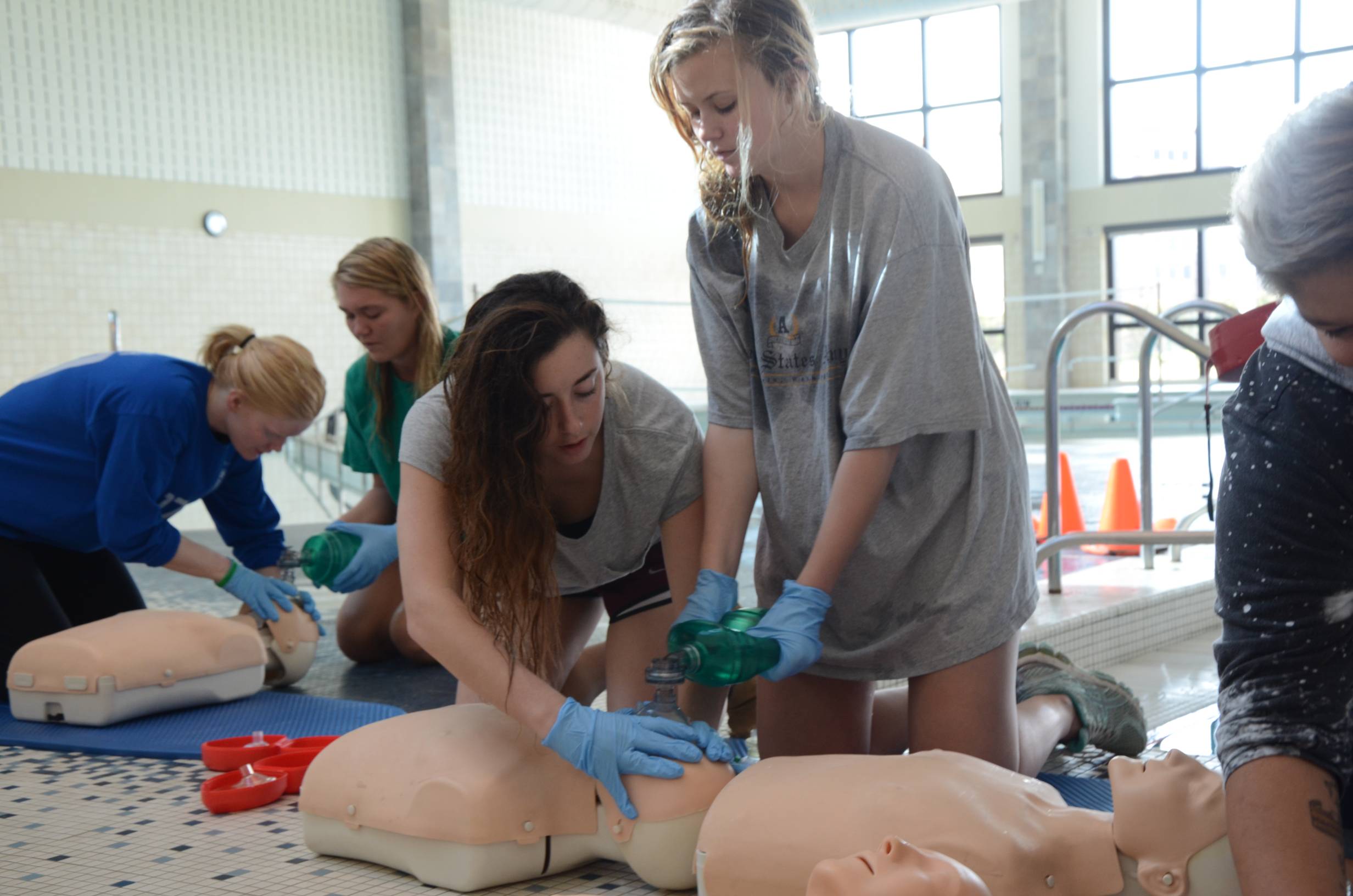
Texas State University, Campus Recreation is an Authorized Provider of the American Red Cross and offers a variety of life saving course. Courses are OSHA Approved.
Certifications We Offer:
-
Basic Water Rescue
Purpose: This is a course that provides participants with the knowledge and skills necessary to prevent, recognize, and respond to aquatic emergencies. It also prepares participants for aquatic emergencies by teaching them how to protect themselves while assisting others. Basic Water Rescue does not provide participants with all the knowledge and skills needed to be certified as a lifeguard.
Prerequisites: None
Learning Objectives:
- Learn water safety guidelines for activities in, on, or around the water.
- Know how to protect yourself while assisting others.
- Recognize the characteristic behaviors of someone who needs help in the water.
- Define an emergency action plan.
- Effectively perform basic water rescue saves and assists.
-
First Aid / CPR / AED
Purpose: This course helps participants recognize and respond appropriately to cardiac, breathing and first aid emergencies. The courses in this program teach the knowledge and skills needed to give immediate care to an injured or ill person and to decide whether advanced medical care is needed.
Prerequisites: None
Learning Objectives:
- Describe how to recognize an emergency.
- How to activate and work with emergency medical services (EMS).
- Demonstrate how to check an unconscious person for life-threatening conditions.
- Demonstrate how to care for a person who is choking.
- Demonstrate how to perform CPR.
- Identify the signals of common sudden illnesses.
-
Lifeguard Training
Purpose:
The primary purpose of the courses in the American Red Cross Lifeguarding program is to provide participants with the knowledge and skills needed to:- Prevent, recognize and respond to aquatic emergencies.
- Provide professional-level care for breathing and cardiac emergencies, injuries, and sudden illnesses until emergency medical services (EMS) professionals take over. Lifeguarding (Including Deep Water) training is conducted and evaluated in water depths ranging from 0 feet to water 7 feet and greater (ranging from 8-12 feet maximum, depending on the depth of the facility in which the training is conducted).
To participate in the Lifeguarding (Including Deep Water) course, participants must:
- Be at least 15 years old on or before the final scheduled session of the Lifeguarding course.
- Successfully complete the two prerequisite swimming skills evaluations:
Prerequisite 1: Compelte a swim-tread-swim sequence without stopping to rest Prerequisite 2: Complete a timed event within 1 minutes, 40 seconds • Jump into the water and totally submerge, resurface then swim 150 yards using the front crawl, breaststroke or a combination of both. (Swimming on the back or side is not permitted. Swim goggles are allowed)
• Maintain position at the surface of the water for 2 minutes by treading water using only the legs
• Swim 50 yards using the front crawl, breaststroke or a combination of both
• Starting in the water, swim 20 yards. (The face may be in or out of the water. Swim goggles are not allowed).
• Submerge to a depth of 7 - 10 feet to retrieve a 10-pound object.
• Return to the surface and swim 20 yards on the back to return to the starting point, holding the object at the surface with both hands and keeping the face out at or near the surface.
• Exit the water without using a ladder or steps.
- We only offer the blended learning version of the Lifeguarding class which combines online sessions with in-person sessions conducted by a Red Cross certified Lifeguarding instructor.
- The online session for the Lifeguarding course has 16 modules and takes approximately 6 hours to complete all modules of the online session.
- Each individual module takes approximately 15 – 30 minutes to complete.
To earn certification, participants must:
- Complete all online course content in advance of the corresponding in-person sessions
- Attend the entire course and participate in all class sessions.
- Actively participate in all course activities, including assuming various roles during skill practices, skill drills, activities and scenarios.
- Demonstrate proficiency in all skills.
- Pass the final written exam with a minimum grade of 80 percent.
- Pass the three (3) final skill assessments.
To maintain the Lifeguarding certification, a currently certified lifeguard must successfully complete the American Red Cross Lifeguarding Recertification course or the full Lifeguarding course again prior to certificate expiration. A 30-day grace period may apply but it does not extend the certification beyond the 2 years.
-
Lifeguard Instructor Training
Purpose: To train current lifeguards to be Certified Lifeguards Instructors. This course uses the American Red Cross Lifeguarding course as its base and reflect the United States Lifeguarding Standards.
Prerequisites:
- Be at least 17 years old on or before the last day of the instructor course.
- Possess one of the following:
- A current American Red Cross certificate for Lifeguarding/First Aid/CPR/AED (Shallow Water Lifeguarding does not qualify).
- A current American Red Cross certificate for Lifeguarding/First Aid and either an American Red Cross certificate for CPR/AED for the Professional Rescuer or an American Red Cross certificate for CPR/AED for Lifeguards.
- An equivalent certificate from another organization (email recsafety@txstate.edu to see if yours qualifies)
- Successfully complete the Online Session for the Lifeguarding Instructor course, which consists of the following:
- Orientation to the American Red Cross
- Orientation to the Lifeguarding Instructor Course and Precourse Exam
-
Water Safety Instructor
Purpose: This course trains instructor candidates to teach courses and presentations in the American Red Cross Swimming and Water Safety program by developing their understanding of how to use the course materials, how to conduct training sessions and how to evaluate participants’ progress.
Prerequisites:
- Be at least 16 years of age on or before the final scheduled lesson of this course.
- Demonstrate the ability to perform the following swimming skills:
- Swim the following strokes consistent with the Stroke Performance Charts, Level 4
- Front crawl—25 yards
- Back crawl—25 yards
- Breaststroke—25 yards
- Elementary backstroke—25 yards
- Sidestroke—25 yards
- Butterfly—15 yards
- Maintain position on back for 1 minute in deep water (floating or sculling).
- Tread water for 1 minute.
- Swim the following strokes consistent with the Stroke Performance Charts, Level 4
Learning Objectives:
- Identify key elements and strategies for planning and preparing effective and safe swim lessons.
- Identify key class management principles, elements, and strategies for planning, preparing, and conducting safe swim lessons.
- Describe the importance of effective observation for teaching and how to develop it.
- Observe swimming, headfirst entry, and diving skills, and accurately classify them and suggest appropriate interventions to improve them.
- Develop the ability to effectively communicate about participants’ progress in swim lessons.
- Modify teaching to meet unexpected challenges, including dealing with participants who misbehave.
- Demonstrate the ability to accommodate participants who move, learn, communicate and behave differently.
Digital certifications are received via email within 3 business days of the course.
For more information on digital certifications, and how to obtain one if you lost yours, please click here. https://www.redcross.org/take-a-class/digital-certificate
Request a Course!
Need to get your staff or a group of people certified? We offer classes that suit your needs and your schedule! Please submit a Rec on Request form to get started!
Contact Us
If you have any questions or concerns please email recsafety@txstate.edu or call 512-245-2940. We are more than happy to help!